The Best Decluttering Rules for People Who Hate Organizing
A practical guide to decluttering for people who dislike organizing, focusing on simple rules that reduce effort, decision fatigue, and everyday friction at home.

Decluttering Without the Pressure to Be Organized
Not everyone enjoys organizing. For some people, labels, bins, and systems feel exhausting rather than calming. If you have ever put off decluttering because you don’t want to turn your home into a perfectly arranged showroom, you are not alone.
The good news is this: decluttering does not require loving organization. In fact, the most effective decluttering rules are often the simplest ones—rules designed for people who want less stuff, not more systems. This approach focuses on relief, not perfection.
Below are decluttering rules that work even if you hate organizing. They are practical, low-effort, and designed to fit into real life.
Rule 1: Declutter for Ease, Not Aesthetics
Many people associate decluttering with making a space look good. That assumption creates pressure and often stops progress before it starts. Instead, declutter for ease.
Ask one simple question:
Does this make my daily life easier or harder?
If something creates friction—extra steps, extra decisions, extra cleaning—it deserves reconsideration. Ease is a more reliable guide than visual appeal.
This mindset shift mirrors the realization many people have when they first notice how excess affects their thinking. You may recognize this moment if you have ever felt relief simply from removing something unnecessary. That experience is explored more deeply in The Moment I Realized I Had Too Much.
Rule 2: If You Don’t Want to Put It Away, You Don’t Want to Own It
One of the clearest signs of excess is avoidance. Items that are always left out, shoved into corners, or moved from chair to chair are often items you do not truly want to manage.
This rule removes guilt from the process. It does not matter whether the item was expensive, gifted, or useful in theory. If you consistently avoid putting it away, it is asking for more energy than you want to give.
Decluttering becomes easier when you stop forcing yourself to maintain things you do not enjoy owning.
Rule 3: One Decision Is Better Than Perfect Decisions
People who dislike organizing often get stuck in decision fatigue. They feel pressure to make the right choice about every item.
Instead, focus on making one clear decision:
- Keep and use it now
- Let it go
There is no third category. Avoid creating piles for “maybe,” “later,” or “I’ll decide someday.” Those piles simply postpone discomfort.
Letting go can feel emotionally heavier than expected. If this resonates, Why Letting Go Feels Like Starting Over explains why the emotional side of decluttering deserves just as much attention as the physical side.
Rule 4: Declutter in Micro-Sessions
Long decluttering sessions are not required. In fact, they are often counterproductive for people who hate organizing.
Instead of setting aside an entire day, use micro-sessions:
- One drawer
- One shelf
- One surface
Stop as soon as you feel resistance building. Progress made in small bursts compounds over time.
This approach aligns closely with habit-based change. If you have seen how small actions create long-term results, the same principle applies here. Decluttering works best when it becomes a low-effort routine rather than a major project, similar to the idea explored in The 5-minute Habit That Gives Long-Term Results.
Rule 5: Reduce the Number of Categories You Own
Organizing often fails because there are too many categories to maintain. Decluttering solves this by reducing categories altogether.
For example:
- Fewer types of kitchen tools
- Fewer clothing styles
- Fewer hobby supplies
When categories shrink, organization becomes almost automatic. You do not need clever storage solutions if there is simply less to manage.
This is one reason minimalism feels freeing to people who dislike organizing. It removes complexity at the source.
Rule 6: Stop Decluttering as a One-Time Event
Decluttering is not something you finish. It is something you maintain lightly.
Instead of aiming for “done,” aim for consistent removal. This might mean:
- Letting go of one item a day
- Clearing one small area each week
- Removing something whenever you notice clutter returning
This steady approach prevents buildup and eliminates the need for major cleanouts.
Over time, your home naturally stays simpler—not because you organize more, but because less enters and less lingers.
Rule 7: Declutter Based on Your Actual Life
A common trap is decluttering for an imagined version of yourself. Clothes for a lifestyle you no longer live, tools for hobbies you do not practice, items saved for “someday.”
Decluttering becomes easier when you align your space with who you are right now.
If “someday” thinking keeps things stuck in your home, How to Let Go of “Someday” Thinking and Start Living Intentionally Now offers a helpful perspective on releasing future-based clutter.
Your home should support your current routines, not your past or hypothetical future.
Rule 8: Make It Easier to Remove Than to Store
For people who hate organizing, storage often becomes a hiding place rather than a solution.
Flip the logic:
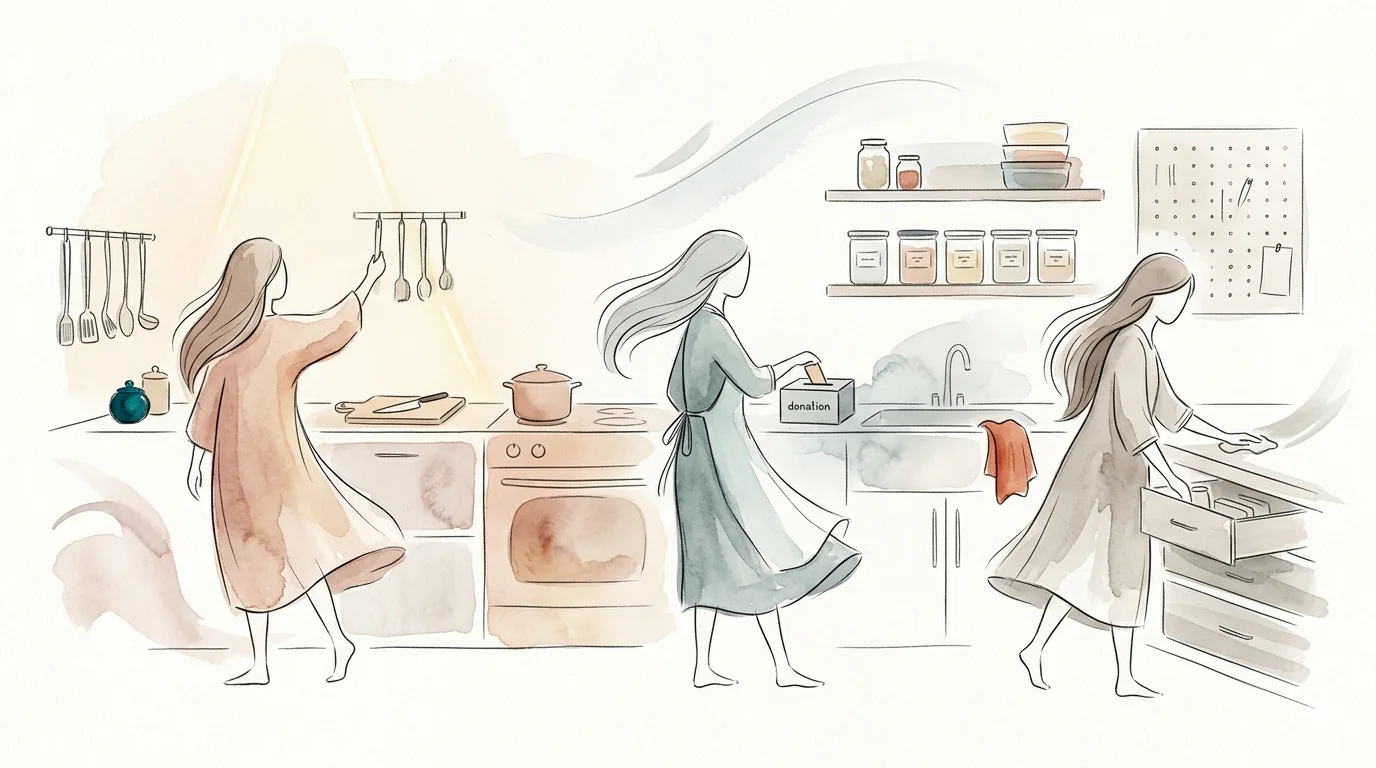
- Keep donation bags visible
- Designate an easy exit spot near the door
- Make removal frictionless
When it is easier to let go than to store, clutter naturally decreases. You do not need discipline—your environment does the work.
This principle also reinforces mindful consumption. When removal is simple, accumulation becomes more intentional.
Rule 9: Decluttering Is a Mindset, Not a Skill
Many people believe they fail at decluttering because they lack organizational skills. In reality, decluttering is primarily a mindset shift.
It is about choosing:
- Fewer obligations
- Fewer decisions
- Fewer visual distractions
Once this mindset settles in, organizing becomes secondary—or unnecessary.
Small mindset changes, repeated consistently, often produce immediate improvements in daily life. This mirrors the effect of tiny behavioral shifts that improve your day without effort, as explored in habit-based approaches.
Living With Less Without Loving Systems
If you hate organizing, you do not need to learn to love it. You only need rules that respect your energy and attention.
Decluttering works best when it:
- Reduces decisions
- Supports real routines
- Removes friction
- Stays flexible
Over time, your home becomes easier to maintain—not because it is perfectly organized, but because it contains only what you are willing to live with.
That is the quiet power of decluttering done simply.