Why Letting Go Feels Like Starting Over
A reflection on the quiet reset that happens when we release what no longer serves us.
Why Releasing Feels Like Beginning
There’s a moment in every person’s life—usually subtle, rarely dramatic—when “enough” becomes visible. It doesn’t arrive with fireworks or epiphanies. It often appears as a small discomfort: a drawer that won’t close, a schedule too tight to breathe, a mind cluttered with half-finished commitments. Letting go begins there, in that barely noticeable tension. And yet, the moment you choose to release something, the world rearranges itself just a little.
Letting go is not just about discarding objects or abandoning old habits. It’s about recognizing that every layer we shed creates room for something new to take shape. That is why the experience feels so much like beginning again—because in many ways, it is.
The Weight You Stop Noticing
There’s a strange thing about familiar burdens: they become invisible. We carry them because they’ve always been there. A stack of books we’ll never read. Clothes we’ve outgrown in all the ways that matter. Digital clutter that demands more attention than it deserves. Expectations—ours and other people’s—packed into the corners of our days.
When we finally decide to let go of something, we’re forced to see it. Its weight becomes evident. And in that clarity, a quiet truth emerges: we weren’t tired because life was hard; we were tired because we were carrying more than we needed.
Letting go isn’t just a release. It’s an awakening.
The Small Reset That Changes Everything
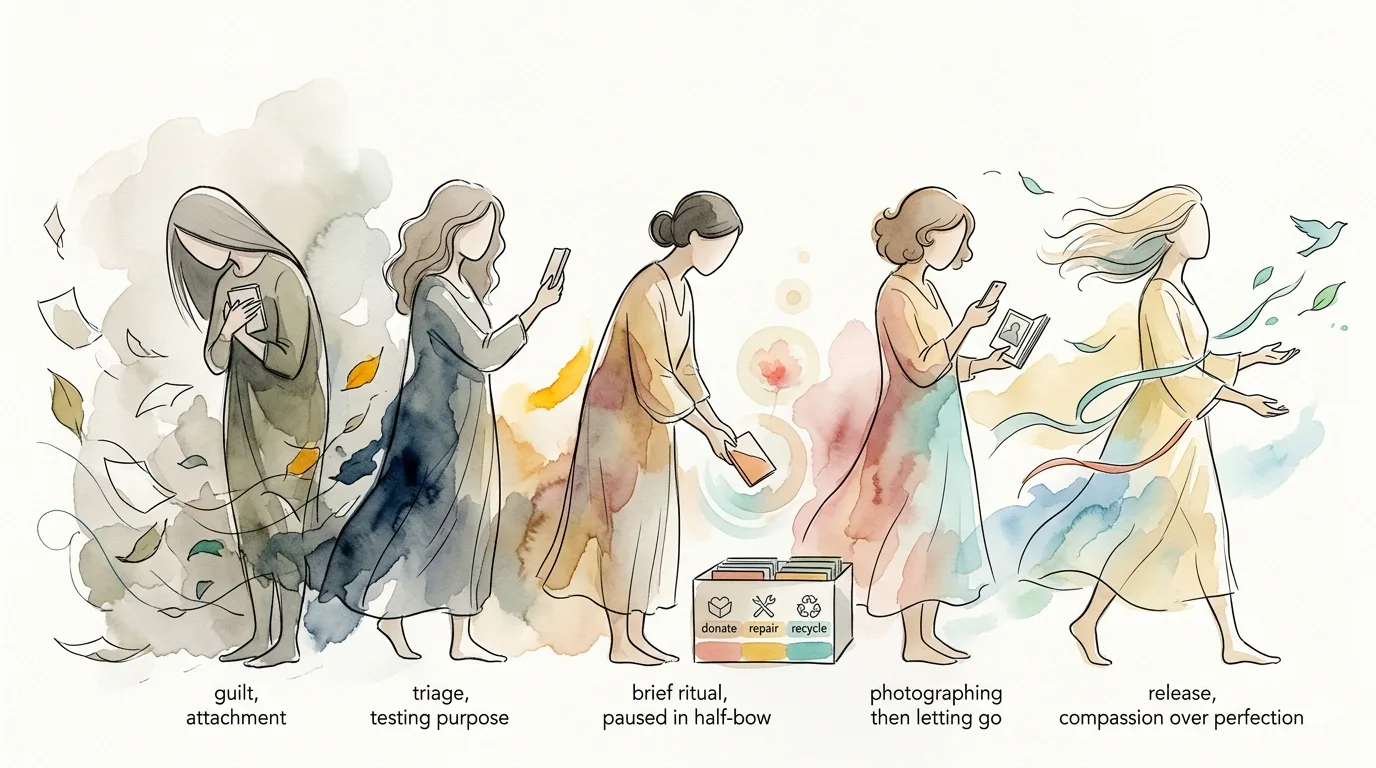
People imagine “starting over” as an event: a big life change, a move, a dramatic transformation. But beginnings often hide inside tiny decisions. The moment you place an unused item into a donation box, you’re choosing a different direction. You’re shifting the story from holding on “just in case” to trusting that the space you create will serve you better.
The reset isn’t in the object leaving your home. It’s in the permission you give yourself to live with less noise.
Minimalism isn’t about deprivation or empty rooms; it’s the courage to create emptiness so something more purposeful can fill it. Letting go is the doorway through which that clarity enters.
When Identity Gets Wrapped in Things
There’s a subtle fear behind releasing what we own. We don’t only part with objects—we part with the version of ourselves connected to them. The guitar we thought we’d learn someday. The craft supplies from a phase that lasted two weeks. The clothes that reflect a person we’re no longer trying to impress.
Letting go forces us to admit that some versions of ourselves never fully arrived. And that is okay.
In fact, it’s liberating.
We are allowed to outgrow who we were. We are allowed to step into a new identity with lighter hands. When we release the physical reminders of old expectations, we create space for a self that feels more aligned with now—not who we once hoped to be.
Space Invites New Stories
There’s a reason an empty room feels peaceful. Space carries possibility. It whispers. It doesn’t demand. It invites.
When you let go—of clutter, of commitments, of roles that drain you—you open doors you didn’t know were closed. Suddenly, you can hear what your life has been trying to say. Not in the loud, dramatic way change is often portrayed, but in a quiet, steady pulse that says: “You can begin again.”
This doesn’t mean the beginning is perfect. It simply means you’ve cleared enough room to notice what truly matters.
The Emotional Echo of Releasing
Letting go can feel like standing in an unfamiliar landscape. Things look different. Your habits shift. Your thoughts move with more intention. That emptiness, at first, can be startling. You may question whether you’ve made a mistake. But emptiness is not loss—it is preparation.
Think of a deep breath: the exhale comes first. Only then does the inhale have room to arrive.
Letting go is the exhale we’ve postponed. Starting over is the inhale that follows naturally.
The New Life Hidden in Simplicity
Modern life teaches us that more equals progress—more skills, more possessions, more achievements. But minimalism suggests a quieter truth: growth often begins with subtraction. Start with one drawer, one commitment, one corner of your day. Observe how the act of releasing transforms everything around it.
You may find that the room looks different. Or that your morning feels less rushed. Or that your mind starts to untangle itself.
And slowly, almost imperceptibly, life begins to feel new.
Not because everything changed, but because you changed the way you move through it.
Letting Go as a Lifelong Practice
Letting go isn’t a single event—it’s a rhythm. A cycle of noticing, releasing, and reclaiming clarity. Some things will be easy to part with. Others will tug at your emotions. Both experiences are equally valuable.
The more you practice, the easier beginnings become. You stop fearing the emptiness that follows release and start welcoming it. You trust that space will always be filled with something better aligned than what came before.
Starting over doesn’t require uprooting your life. It can begin with the simple act of choosing what to keep.
A Gentle Invitation
Look around your space. Notice one thing that no longer matches the person you’re becoming. One object, one digital file, one expectation. Let it go.
Not because minimalism demands it, but because you deserve the clarity that follows.
Beginnings rarely announce themselves. They arrive softly—often disguised as a moment of release.