How to Arrange Small Entryways to Reduce Clutter and Stress
A step-by-step guide to editing, designing, and maintaining small entryways so they stay clutter-free with simple storage choices and tiny daily habits.
Why your entryway matters
Your entryway is the first thing you — and guests — experience every day. In small homes it’s also the place where daily life either flows or immediately clogs. A crowded entryway silently amplifies stress: lost keys, a pile of mail that feels like a small crisis, shoes spread across the floor. But with a few low-effort design choices and tiny habits, a small entryway can become a calm, efficient transition space that reduces decision fatigue before you even step fully into the house.
This post shows how to edit, design, and maintain a compact entryway so it stays tidy with minimal effort. The goal: tools and routines that remove friction, not a Pinterest-perfect installation you can’t maintain.
Start by editing: what to remove first
Clutter won’t be solved with prettier storage if there’s too much stuff. The single most important step is to decide what truly needs to live near the door.
- Do a five-minute purge: set a timer and empty the entryway. Sort items into three piles: keep nearby, move elsewhere, donate/recycle. If you find things that haven’t left the entryway in months, they probably belong somewhere else.
- Ask one simple question for each item: “Does this item belong here to make my next trip easier?” If the answer is no, relocate it.
- Limit the categories that can live in the entryway to 3–4 essentials: outerwear, shoes, keys/wallet, and daily mail/packages. Everything else creates visual noise and makes maintenance harder.
If you want systems that stick beyond the initial edit, pairing these changes with small daily routines helps — for a short routine that complements this, look into a five-minute evening reset to clear what’s accumulated each day.
Design zones for function (even in 3 feet of space)
Think of the entryway as a small map with clear zones. Even a narrow entry benefits from division: drop zone, outerwear zone, shoe zone, and a mail/keys zone.
Drop zone (the immediate surface)
Keep a slim console table or a floating shelf for the single most important temporary items: keys, phone, and the day’s outgoing envelope. Use a bowl or shallow tray so things don’t migrate across the surface. The rule here: only what leaves with you should live on the drop zone.
Outerwear zone
A small wall of hooks is more space-efficient than a bulky coat rack. Install hooks at two heights if you share the space with kids: high for adults, low for kids and reusable bags. Consider a single closed cabinet for formal coats if visual calm is a priority.
Shoe zone
Contain shoes with a narrow bench that doubles as a seat. Under-bench baskets or a slatted shoe shelf keep dirt off the floor and make it easier to tidy quickly. Adopt a maximum — for example, 3 pairs per person in the entryway — and store extras elsewhere.
Mail and keys zone
Create a dedicated, vertical mail slot, wall organizer, or slim basket labeled “inbox” so mail doesn’t become a pile. Hang keys on a visible hook or use a magnetic key tray attached to the drop surface. The moment mail arrives, decide: act now (pay a bill, reply), recycle, or place in the designated outbox for items leaving the next day.
Storage solutions that make sense in tight spaces
The trick in small entryways is vertical thinking and multifunctional items. You want storage that does double duty and reduces visual clutter.
- Vertical hooks and rails: A horizontal rail with modular hooks and small baskets lets you change the configuration for seasons or needs.
- Slim console with drawers: Choose a narrow piece with one shallow drawer for keys and a hidden cubby for sunglasses and masks. Keep the drawer reserved for only those immediate-leave items.
- Bench with hidden storage: A bench that opens or contains baskets underneath provides seating plus concealed shoe storage.
- Wall-mounted baskets or cubbies: Use one or two small cubes for gloves, a dog leash, or wallet. Label them if multiple people use the space.
- Magnetic strips and pegs: Great for small metallic items such as keys, or for hanging lightweight sunglasses and lanyards.
Choose storage that matches your maintenance willingness: if you’re someone who avoids daily shelf-straightening, prefer closed storage and a single visible surface.
Light, color, and minimal cues for calm
Small spaces feel larger when they’re bright and intentional. Keep the palette light and use clear pathways of negative space.
- Paint the entry wall a light, warm color or keep it white to reflect light.
- Use one statement item (a mirror or a single piece of art) rather than many small decorations.
- A mirror above the drop zone doubles the visual space and gives you one last look before leaving.
These small visual rules reduce the cognitive noise of too many competing items.
Habits that keep clutter from returning
Design + habit = long-term calm. The most beautiful entryway will fail without a few consistent tiny habits.
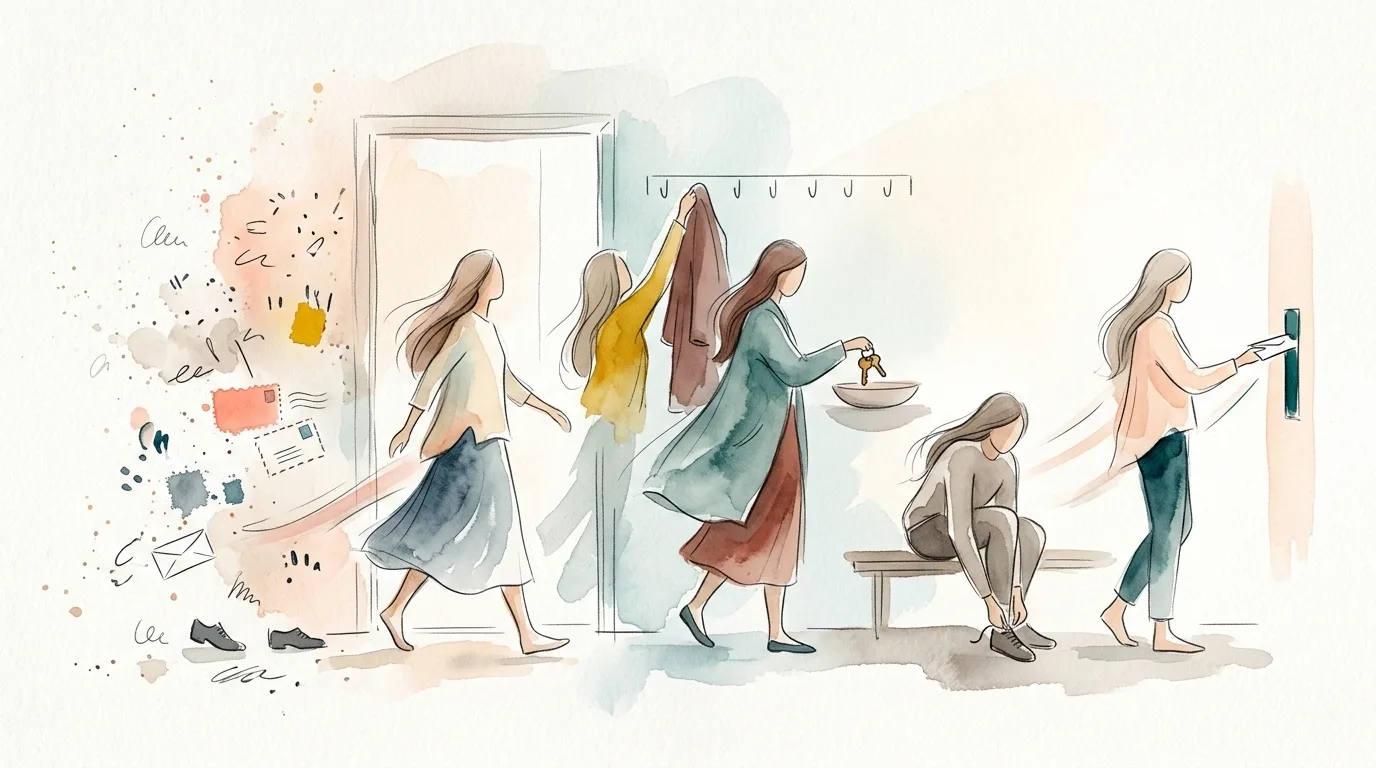
- The 30-second arrival rule: when you come in, put keys in the bowl, hang coat, and drop the day’s bag in its basket. Treat it like an automatic subroutine.
- The one-out rule: every time you add a new coat or bag to the entryway, remove one item you use less. This keeps accumulation steady.
- Weekly reset: pick one day (Sunday works well) to quickly run a 5–10 minute tidy through the entryway: sweep, remove shoes that don’t belong, and clear the mail inbox.
- Habit stack: attach the 30-second arrival rule to another daily action, e.g., immediately after you turn off the car engine or after you unlock the door. Small triggers make the routine automatic.
For deeper habit-building, consider combining these with other home systems. If you’re interested in broader organization routines, these home organization hacks that stick offer systems that pair well with an entryway plan.
A 7-day small-entryway refresh plan
Make changes incrementally so they last. Here’s a simple schedule you can follow in under 30 minutes each day.
- Day 1 — Empty and sort: clear everything and apply the three-pile rule (keep near door, move elsewhere, donate).
- Day 2 — Install vertical hooks and a key bowl. Measure before buying to avoid awkward pieces.
- Day 3 — Add shoe containment: a narrow bench or under-bench baskets.
- Day 4 — Create a mail system: one inbox and one outbox; decide a path for action or recycle.
- Day 5 — Tidy and style minimally: add a mirror and one decorative item.
- Day 6 — Practice the arrival rule for a full day and note what’s still out of place.
- Day 7 — Adjust: move items that caused friction to better spots and commit to the weekly reset day.
By the end of the week you’ll have a functional system and a set of tiny habits to keep it that way.
Troubleshooting common small-entryway problems
- If shoes keep spilling out: limit visible pairs and store seasonal shoes elsewhere. Use a lower shelf or basket labeled with each family member’s name.
- If mail piles up: move the inbox to a place where you sit down to open mail (kitchen counter, not the entryway) to encourage action. Recycle flyers immediately.
- If coats pile up: add one or two extra hooks, but pair that with the one-in-one-out rule so the extra capacity doesn’t become an invitation to hoard.
The psychological benefit: less visual noise = less cognitive load
A tidy entryway does more than tidy your floor — it reduces small daily stresses. Coming home to a calm threshold signals your brain that the day can slow down; leaving from a clear, organized spot reduces the friction of departure. Cumulatively, these tiny reductions in friction save time, attention, and decision energy.
Small changes, regular tiny habits, and a short weekly reset create a quiet, resilient entryway that supports your day instead of sabotaging it. Start with the edit, design clear zones, pick one storage upgrade, and build a 30‑second arrival habit — those four moves will transform a cramped entrance into a calm, clutter-free threshold.
Key takeaways: edit first, design zones, choose vertical and multifunctional storage, and build tiny habits that make maintenance automatic.