How to Build a Seven-Minute Evening Reset That Prevents Clutter
A seven-minute, repeatable evening routine to capture stray items, make quick decisions, and restore key surfaces so clutter never accumulates.
Why seven minutes matters
By the time you collapse on the couch at night, a dozen small things have migrated from your hands and pockets onto tables, counters, and chair backs. If ignored, those small things become the clutter you wake up to — and the clutter becomes a daily drag on focus and calm.
Seven minutes is a sweet spot: long enough to do meaningful reset work, short enough to feel effortless and actually get done every night. This post gives a simple, repeatable seven-minute evening reset that prevents clutter from accumulating and trains a calm, minimalist home rhythm over time.
The idea behind a tiny nightly reset
Tiny habits win because they’re specific, repeatable, and low-friction. A seven-minute evening reset turns a vague ambition (“I should tidy more”) into a reliable micro-routine you can stack onto something you already do, like brushing your teeth or turning off the lights.
Think of the reset as three functions in one fast loop:
- Capture: gather stray items that belong elsewhere.
- Release: make small discard or donate decisions quickly.
- Arrange: restore surfaces to intentional, useful states.
Those three moves, repeated nightly, stop clutter from ever becoming a weekend chore.
The seven-minute reset: a minute-by-minute blueprint
Below is a flexible, minute-by-minute plan. Adjust order to fit your home and priorities, but keep the total time to seven minutes.
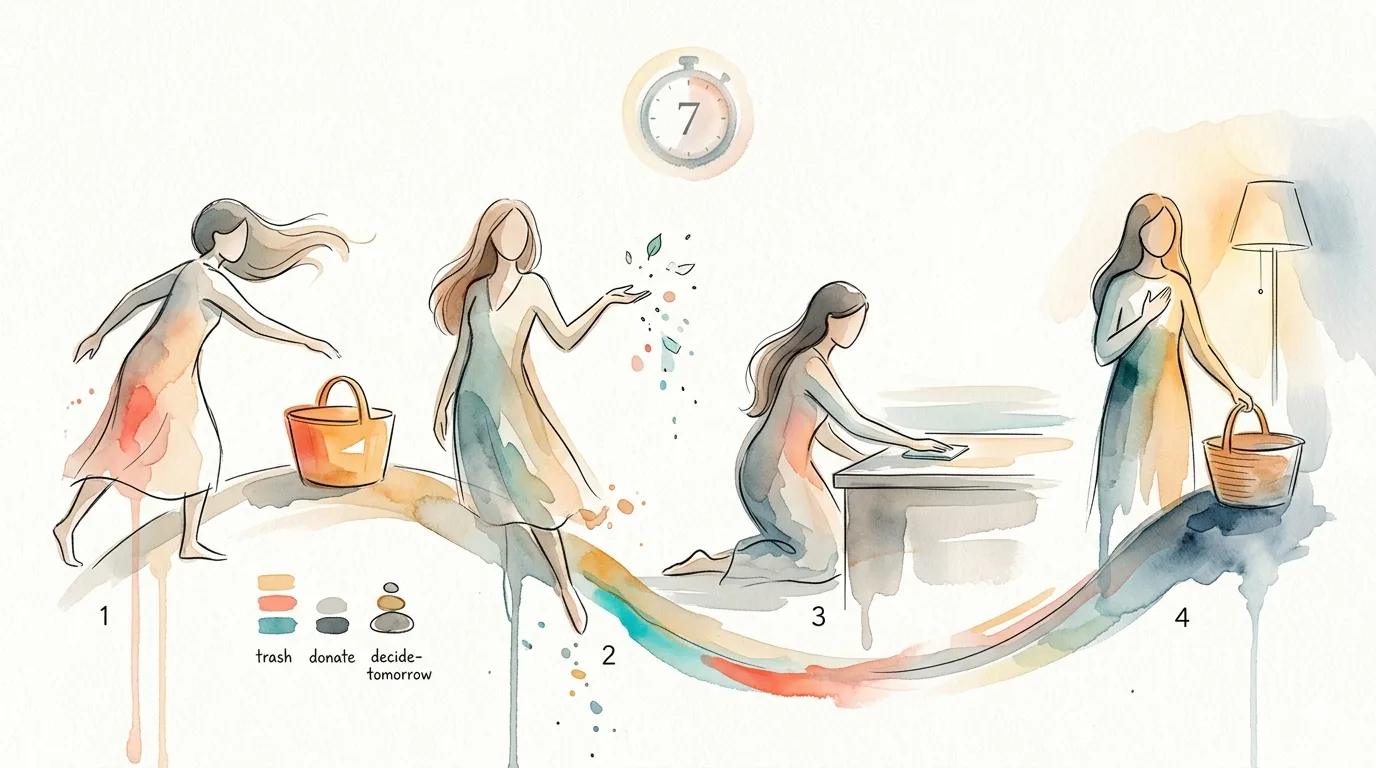
Minute 0–1: Start with a cue and a basket
Set a consistent cue to begin (e.g., after washing dinner dishes or five minutes after you turn on the bedroom lamp). Keep an open-top basket, tote, or laundry bin in a central spot. The cue + basket combo makes the habit obvious and frictionless.
Action: set a timer for seven minutes and place the basket where you’ll collect things that belong elsewhere.
Minute 1–2: Do a fast sweep of common drop zones
Walk a predetermined route: entry table, living room surface, kitchen counter, bedroom chair. Move quickly — the goal is capture, not decisions.
Action: put all out-of-place items in the basket. Phones that need charging can go to their charging station; loose mail goes in the inbox there; toys go in the toy bin if you have one.
Minute 2–3: Quick decisions — trash, donate, keep
Open the basket and make three snap decisions for obvious items.
Action: create three piles on a chair or table: trash, donate/return, put away tonight. Be ruthless with anything that’s been sitting unused or doesn’t belong.
Tip: use the one-in-one-out mindset: if you keep something new, consider removing something old.
Minute 3–4: Put away the night-time items
Handle the small, quick put-aways. If an item will take less than 20 seconds to return to its home, do it now.
Action examples: hang keys, return dishes to the sink/dishwasher, drop a book back on its shelf, toss a receipt in the paper envelope for financial records.
Minute 4–5: Deal with the tricky stuff fast
If something requires a longer decision (sentimental items, large donations, paperwork), don’t stall. Create a single “decide tomorrow” folder or bin and move the item there.
Action: label the bin/folder with the date. Avoid making tonight the night you solve every decision — the point is to prevent clutter, not to burn out.
Minute 5–6: Surface reset and smoothing
Clear one or two key surfaces where your eyes rest in the morning and evening — the kitchen counter and entryway table, for example.
Action: wipe or tidy those surfaces briefly (a quick wipe with a cloth or rearranging to a simple, calming layout). This small visual reset reduces decision fatigue the next day.
Minute 6–7: Ritual finish and habit stack
End by returning the basket to its storage spot and placing an encouraging cue for morning: set a bag by the door if you packed lunches, charge your phone in its spot, or prepare tomorrow’s outfit.
Action: say a one-sentence affirmation — “Home reset complete.” This tiny verbal reward helps the brain mark the routine as finished.
Why this works: psychology and systems
- Low friction: Seven minutes is short enough to remove excuses. When a habit feels achievable, it becomes consistent.
- Small wins: Clearing even one surface reduces visual clutter and gives a sense of completion, which reinforces the behavior.
- Decision limits: The “decide tomorrow” bin prevents decision paralysis and avoids late-night regret.
- Habit stacking: Tying the reset to an existing nightly cue dramatically increases the chance you’ll do it.
If you prefer a slightly shorter option, consider the five-minute reset variation explained in the guide on the five-minute evening reset. It’s a close cousin and useful when you want an even lighter version: five-minute evening reset.
Troubleshooting: common obstacles and fixes
-
Obstacle: “I forget.” Fix: set an alarm labeled “7-minute reset” 10 minutes before your usual bedtime, and keep the basket visible.
-
Obstacle: “My partner doesn’t do it.” Fix: make it your personal reset first. People follow habits more easily when they see the benefit in calm, not when they feel judged.
-
Obstacle: “Decisions take too long.” Fix: use a three-option rule (trash, donate/return, decide tomorrow). Limit yourself to one taxing decision per week.
-
Obstacle: “The house is too big.” Fix: pick one zone each night and rotate rooms over the week. Seven minutes in the kitchen on Monday, living room on Tuesday, and so on will keep every room regularly addressed.
How to make it stick beyond the first month
- Habit scorecard: for 21 nights, mark a small calendar sticker. Visible streaks create momentum.
- Celebrate micro-progress: notice the mornings when surfaces feel calm and note how much faster your mornings are.
- Upgrade slowly: after a month, add one extra minute to build deeper habits — maybe five minutes for paperwork on Sundays.
- Pair with a weekly reset: this nightly practice dramatically reduces the time needed for a weekly reset because you’ve already prevented the mess from forming. If you want a routine for a longer refresh, consider building a weekly reset habit later.
Minimalism and clutter prevention: how the reset supports bigger change
A seven-minute reset isn’t a purge plan — it’s the maintenance system that keeps your home functional while you make longer-term decisions about what belongs. Over weeks and months, consistent resets reveal patterns: which items repeatedly land in the donate pile, which surfaces often collect things, and where storage doesn’t match behavior. Those observations are the best guide for meaningful decluttering.
If you’re revisiting why you keep certain things, there are techniques that help reframe attachment and decision-making; a focused read on letting go can deepen the impact of your nightly routine.
A simple checklist you can copy tonight
- Timer: set for 7 minutes
- Basket/bin: placed centrally
- Route: entry → living room → kitchen → bedroom
- Piles: trash / donate/return / decide tomorrow
- Surface reset: wipe or rearrange one visible surface
- Close: return basket and set morning cue
Repeat nightly. Adjust once a week or month based on what’s piling up.
Final thought
A seven-minute evening reset doesn’t make your home perfect. It reduces the daily buildup that turns life into a constant tidy-up. The secret is consistency: seven minutes every night creates a home that serves you instead of distracting you. Over time, those small resets compound into more space, clearer choices, and the calm you actually notice when you walk through the door.