Top 5 Tiny Daily Habits That Quietly Reduce Household Clutter
Five tiny daily habits—each under five minutes—that quietly stop clutter from building and make a home feel calmer and easier to maintain.
Why tiny habits beat occasional purges
Clutter doesn’t arrive in dramatic weekends. It sneaks in—one stray paper, one misplaced pair of keys, one new mug left on the counter. The truth is: the daily moments matter more than the big cleans. Small habits, done consistently, quiet the accumulation before it becomes a crisis. This post outlines five tiny daily habits that cost minutes but save hours of stress, decision fatigue, and late-night tidying.
The top 5 tiny daily habits that actually work
Below are habits you can adopt in under five minutes each day. For each, I explain why it works, how to start, and a quick habit-stack you can use so the new action becomes automatic.
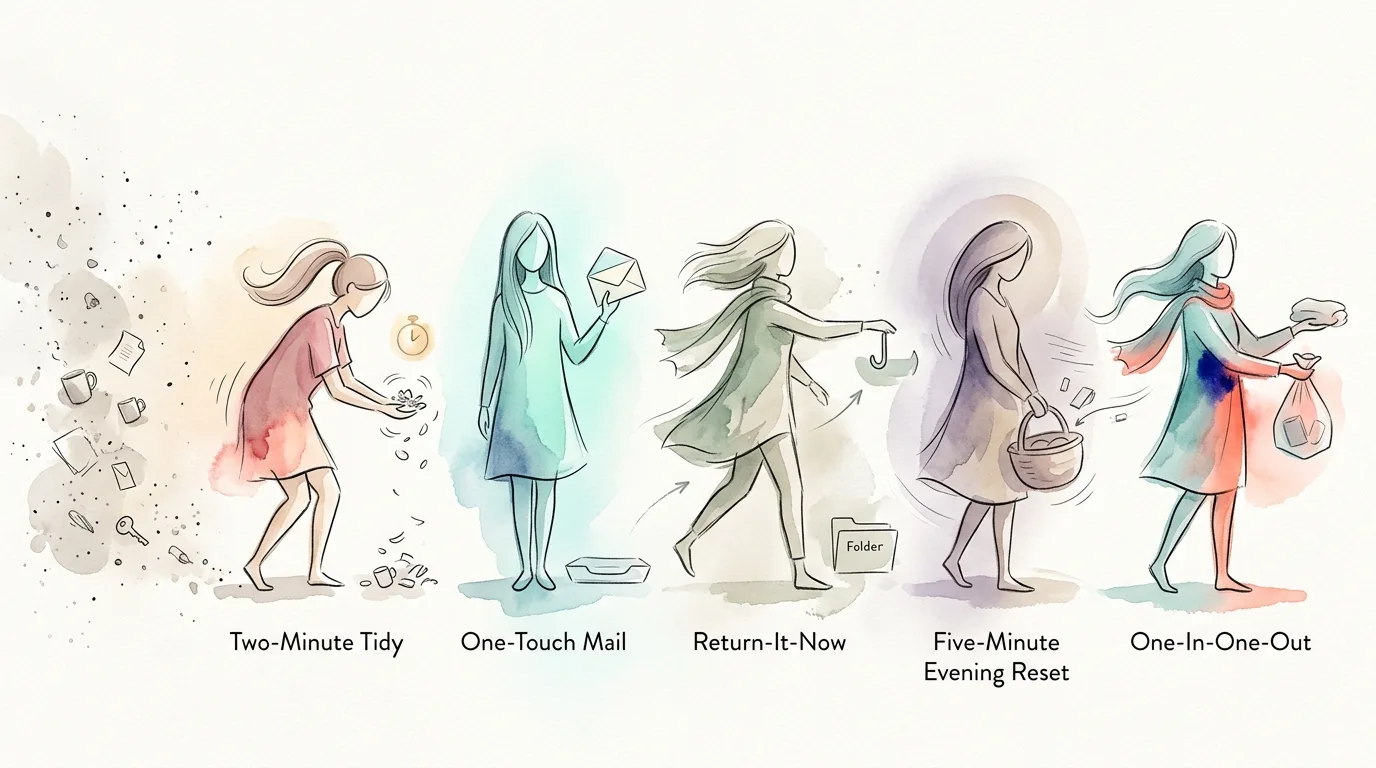
1) The Two-Minute Tidy
What it is: Spend two minutes when you notice clutter—and do the simplest corrective action (put something away, toss trash, or sort a small pile).
Why it works: Small actions avoid decision paralysis and interrupt clutter cycles. The psychology behind it is simple: short, satisfying wins create momentum.
How to start:
- Set a timer for 2 minutes. Pick one hotspot (entryway, kitchen counter, desk).
- Pick five visible items and either return, recycle, or discard them.
- Stop when the timer rings. That’s the point.
Habit stack: After you wash your hands, do the two-minute tidy.
Time cost: 2 minutes. Frequency: multiple times a day when you pass hotspots.
If you want a framework that teaches this rule specifically for staying minimal and productive, check the two-minute rule.
2) The One-Touch Mail and Paper Rule
What it is: Deal with each piece of paper or mail the first time you touch it—either recycle, file, act on it, or schedule it.
Why it works: Paper is the classic slow-burning clutter source. One-touch prevents stacks from forming and reduces follow-up tasks.
How to start:
- Keep a shallow tray or basket for any incoming physical mail, and immediately open it.
- Decide in 10 seconds: trash, file, or action. If it requires work, write the deadline on it and place it in a visible “today” folder.
Habit stack: After you put groceries away, sort the day’s mail.
Time cost: 15–60 seconds per item. Frequency: once or twice daily.
3) The Return-It-Now Rule (Put-It-Back)
What it is: When you use something, return it to its home immediately instead of leaving it out “for later.”
Why it works: Most clutter is a misplacement problem, not a quantity problem. If everything has a home and you return items instantly, surfaces stay clear.
How to start:
- Choose 5 frequently out-of-place items (keys, charger, remote, mug, mail). Create a clear, convenient home for each.
- For one week, commit to returning these 5 items immediately after use.
Habit stack: After you take off your shoes, put keys and bag away.
Time cost: 5–20 seconds per item. Frequency: whenever you use the item.
Pro tip: Make homes visible and easy—hooks at eye level, a catch-all tray, cord organizers. Convenience wins.
4) The Five-Minute Evening Reset
What it is: A short nightly routine to restore order to visible spaces (kitchen counters, living room surfaces, and the entryway) before bed.
Why it works: Ending the day with tidy spaces creates daily momentum and reduces morning stress. It’s also a gentle cue to stop new accumulation overnight.
How to start:
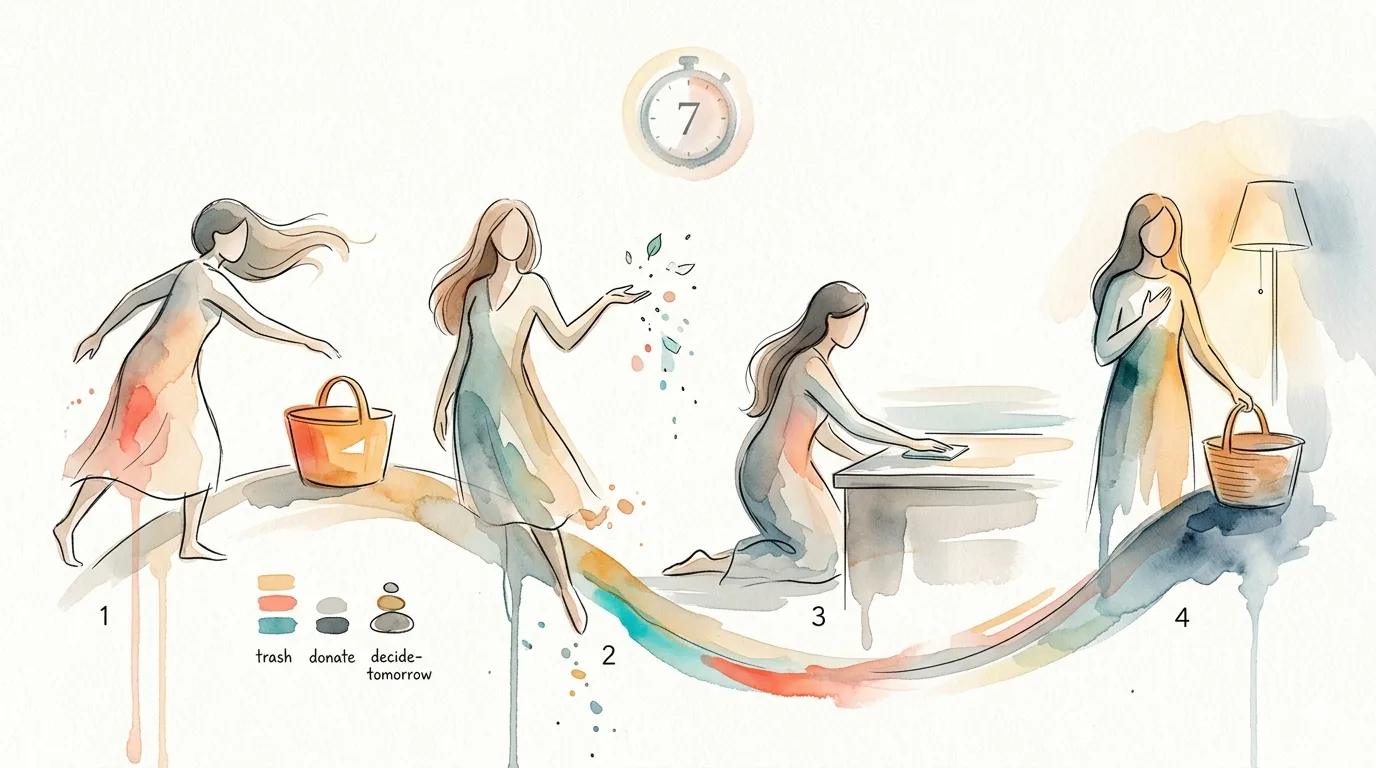
- Set a 5-minute timer. Move through the home with a basket: dishes to sink/dishwasher, laundry to hamper, items returned to homes, and garbage/recycling emptied.
- Keep the basket near a central spot so it’s easy to use nightly.
Habit stack: Right after brushing your teeth, run the five-minute reset.
Time cost: 5 minutes. Frequency: nightly.
If you’d like a step-by-step habit plan for building this into your life, see the five-minute evening reset.
5) The One-In-One-Out Rule
What it is: For every new item you bring into the home, remove one existing item of similar utility or sentimental weight.
Why it works: Prevents slow growth of possessions and keeps your collection aligned with what you actually use.
How to start:
- Apply the rule to specific categories first—clothes, kitchen gadgets, or kids’ toys.
- When you buy something new, immediately pick one item to donate or recycle.
Habit stack: Before you put a new item away, choose one to remove and place it in a donation bag.
Time cost: 30–90 seconds per new item. Frequency: per acquisition.
If you want a practical guide to this mindset and how to make it a habit, read about the one-in-one-out rule.
How to make tiny habits stick (the non-fluffy version)
Tiny habits fail when they’re vague, inconvenient, or unconnected to your daily rhythm. Use these simple techniques to lock them in:
- Make it obvious: Use visual cues (a basket by the door, a labeled tray) so you don’t rely on memory.
- Stack reliably: Attach the new habit to a daily anchor you never skip—coffee, teeth-brushing, or the commute.
- Start ridiculously small: If five minutes feels hard, do one minute. The point is continuity.
- Use the same place and time: Routines cement faster when context is stable.
- Celebrate the tiny win: A silent thumbs-up or marking a habit tracker reinforces the behavior.
If you already struggle with late-night messes, prioritize the evening reset. If new purchases are the main issue, lock in the one-in-one-out rule. The habits below often work best together rather than alone.
Sample 15-minute daily flow that prevents clutter
- Morning (2 minutes): Two-minute tidy at the entry—hang coats, return shoes.
- Midday (1–3 minutes): One-touch mail check and quick sort after lunch.
- Evening (5 minutes): Five-minute evening reset after teeth brushing.
- As-needed (variable): Return-it-now whenever you finish using something.
- Acquisition rule: One-in-one-out applied whenever you buy.
This flow keeps the hard work under twenty minutes total across a day, but the real win is that each moment prevents the exponential growth of clutter.
Troubleshooting common obstacles
- “I forget to do them.” Use alarms for the first 30 days and habit-stack onto unskippable anchors.
- “I live with others who don’t help.” Teach one habit at a time; make participation effortless (e.g., a single shared basket for donations). Invite them to try a 7-day challenge rather than impose rules.
- “My home has no clear storage.” Start with visible, simple homes: baskets, hooks, and labeled bins. Complexity comes later—clarity comes first.
- “I keep meaning to declutter but never start.” Replace vague intentions with a 2-minute tidy. Momentum lowers the activation energy for bigger projects.
Why tiny beats tidy: the long-term payoff
Small, consistent actions shift the home’s default state from messy to manageable. They change how you relate to objects and decisions—less friction, fewer choices, and fewer exceptions. Over weeks, surface clutter vanishes; over months, shopping habits and expectations shift.
These habits aren’t punishment. They’re tiny investments that buy back time, calm, and a home that breathes.
Final thought
Pick one habit and commit to it for two weeks. Habit stacking makes progress nearly effortless: tie it to something you already do, keep it small, and celebrate each day you follow through. The sum of these tiny habits is a quieter, lighter home—and a quieter, lighter mind.