Top 5 Evening Money Habits to Avoid Morning Stress
Five simple, under-10-minute evening money habits—quick finance sweep, prepping spending, clearing one task, automating annoyances, and a one-sentence plan—to remove morning financial stress and create calm routines.

Why an evening money routine matters
Some mornings begin with a calm cup of coffee and a clear head. Others start with a sinking feeling: where’s my wallet, did that bill auto-pay, how much can I actually spend today? The difference rarely comes from the alarm clock — it comes from what you did the night before.
An evening money routine is less about spreadsheets and more about small, repeatable habits that remove decision friction and anxiety in the morning. Here are five evening money habits that take 10 minutes or less and dramatically reduce morning stress, plus tiny habit variations you can actually stick to.
Habit 1 — Do a 3-minute “day-close” finance sweep
What it is: A quick check of yesterday’s spending, any bills due today, and your upcoming cash needs.
Why it works: You don’t carry yesterday’s uncertainty into today. A short review keeps surprises small and solvable.
How to do it (10 minutes max):
- Open your bank or budgeting app and scan for one-off transactions or pending bills.
- Mark anything that needs follow-up: return a charge, dispute a fee, or flag a recurring charge you didn’t expect.
- Note cash or card you’ll need tomorrow (commute, lunch, childcare) and adjust your wallet or app balance accordingly.
Tiny habit variation: Right after brushing your teeth, tap your budgeting app for 60 seconds. Habit stacking makes this simple and consistent.
Habit 2 — Prepare tomorrow’s spending envelope (digital or physical)
What it is: Decide how much you’ll spend tomorrow and set it aside.
Why it works: Clear boundaries prevent impulse pressure in the morning and limit decision fatigue later.
How to do it:
- If you use cash envelopes, slide the day’s cash into the right envelope. If not, create a temporary tag in your banking app or a labeled note in your wallet app.
- Name the tag (e.g., “Lunch + Commute — Tue”) and transfer or earmark the exact amount.
- If you expect a single larger expense (groceries, gift), plan it tonight so you won’t be surprised.
Tiny habit variation: Keep an “essentials” template in your notes app. Duplicate and tweak it each evening in under a minute.
Habit 3 — Tidy one financial task: bills, subscriptions, or receipts
What it is: Finish one small administrative money task before bed.
Why it works: Financial paperwork is a compounding source of stress. Clearing a small task nightly prevents an unwieldy pile.
How to do it (choose one):
- Pay a bill that’s due tomorrow or schedule the payment for a few minutes later.
- Cancel or flag an unnecessary subscription you noticed in your bank sweep.
- Photograph and file a receipt in your expense folder or app.
If you’re short on time, do the single smallest action that yields progress: hit “pay,” Archive an email, or snap a pic of a receipt. For more on simplifying recurring costs, see this guide to simplify your bills.
Habit 4 — Automate one recurring annoyance
What it is: Set or review one automaton that prevents future morning scrambling.
Why it works: Automation reduces decisions and eliminates forgotten tasks — both big sources of morning anxiety.
How to do it:
- Turn on autopay for a regular, low-variance bill you won’t need to micromanage.
- Set a calendar reminder for variable payments (insurance, quarterly taxes) at a predictable time rather than relying on memory.
- Use alerts: low-balance notifications, bill-approaching reminders, or payment confirmations.
Tiny habit variation: Once a week, spend five minutes scanning for a single repetitive task you can automate. Over time this compounds into a calmer financial life.
Habit 5 — Close your mental loop with a one-sentence plan
What it is: Write one sentence that tells your morning brain what it needs to know about money tomorrow.
Why it works: Clarity wins. Your brain stops rehearsing “what if” scenarios overnight when it has a simple instruction to follow.
How to do it:
- Write: “Tomorrow: $8 bus, $12 lunch, don’t buy coffee” or “Pay electricity bill at 8 a.m.”
- Place this note on your phone home screen, in your planner, or as a sticky on the fridge where you’ll see it first thing.
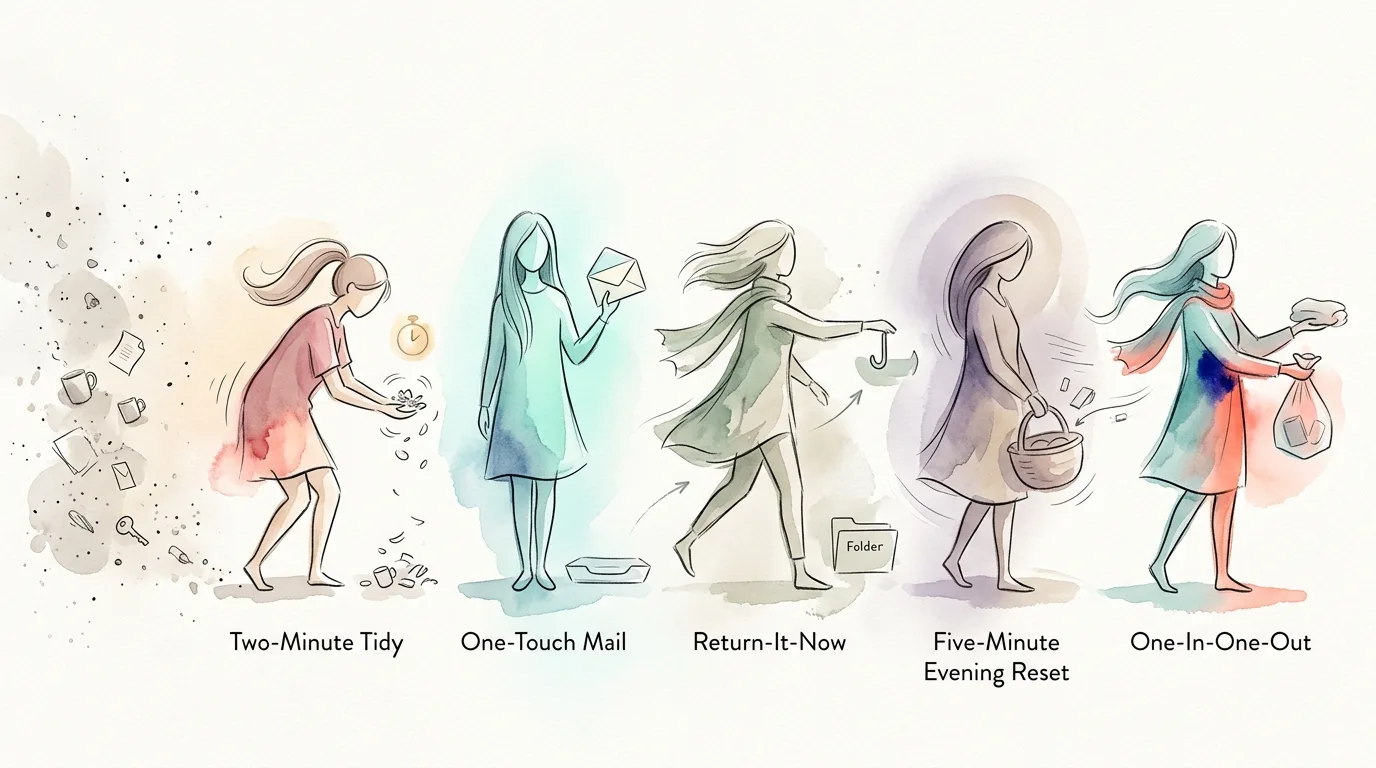
This is similar to a five-minute reset habit that prevents clutter and prepares you for the next day — transferring that mindset to money saves mental energy in the morning. If you want a quick routine to build this into your evening, the five-minute evening reset habit is a great model to adapt.
Build these into a simple weekly rhythm
Evening habits are easiest to keep when they’re small and predictable. Here’s a minimal weekly plan you can follow and adapt:
- Nightly (3–10 minutes): Day-close sweep + one-sentence plan.
- Every other night (1–3 minutes): Prepare tomorrow’s spending envelope.
- Twice weekly (5–10 minutes): Tidy one financial task (pay a bill, file receipts).
- Weekly (5 minutes): Review and automate one recurring annoyance.
Over a month, these 10–20 minutes a week will reduce the time you spend dealing with money surprises and remove the morning scramble that steals focus.
Small changes that compound into calm mornings
The goal isn’t to become a spreadsheet hermit — it’s to build tiny, repeatable actions that push friction out of your morning. These habits are intentionally short: they trade a little evening attention for large mental returns. You’ll notice fewer hedged thoughts at the sink and more clarity when you step out the door.
Pick one habit to start tonight. Keep it under five minutes. Repeat it for a week. When it feels automatic, add one more. In a month, mornings won’t feel like crisis management; they’ll feel like the peaceful beginning of your day.