How to Build a Daily Minimalism Check-In Habit in 21 Days
A step-by-step 21-day plan to establish a daily minimalism check-in habit in under five minutes. Learn how to anchor the habit, expand with micro-actions, habit-stack for consistency, troubleshoot obstacles, and integrate weekly resets so minimalism becomes a daily rhythm.

Why a daily minimalism check-in matters
Minimalism is easy to explain and hard to habitually practice. We can declutter once, donate a box, and feel lighter—but the small daily choices (what we buy, where we place things, what we keep on our counters) quietly rebuild clutter. A tiny daily check-in turns intention into momentum. It shifts minimalism from an occasional project into a living mindset that reshapes your home, time, and attention.
This post gives a 21-day, bite-sized plan to build a daily minimalism check-in habit—one that fits into five minutes or less and becomes a durable rhythm. The goal is not perfection; it’s consistent alignment with what matters.
The 21-day framework: how the plan progresses
Why 21 days? It’s long enough to establish repeat action but short enough to feel achievable. The plan uses gradual scaling: start tiny, add a small decision or action, then stabilize the routine.
- Days 1–7: Anchor and automate. Create an unmissable cue and do the smallest check-in possible. Success here is repetition.
- Days 8–14: Expand the scope. Add a quick action tied to one decision point (purchase, surface clutter, or a single drawer).
- Days 15–21: Integrate values and review. Use a one-minute reflection and a weekly 10-minute reset to lock the habit into identity.
Daily checklist template (under five minutes)
Use this template each morning or evening. It’s built to stack onto an existing habit (coffee, brushing teeth, winding down). If you don’t already habit-stack, pick a consistent part of your day as the cue.
- Cue: Your chosen anchor (example: after morning coffee or before locking your front door).
- 30-second look: Scan one zone (kitchen counter, entryway, nightstand).
- 60-second decide: For any item out of place, choose one of three actions—return it, donate/remove, or schedule time to address later.
- 60-second tidy: Move up to three items into their rightful place.
- 30-second alignment check: Ask one quick question: “Does this help me live the life I want?” If the answer is no, add the item to a donate/sell list.
Total time: about 3–4 minutes.
Days 1–7: Anchor, repeat, reward
Choose a single cue and commit: place a sticky note on your coffee maker, set a phone reminder right after your evening show, or stack the habit on your toothbrush. Keep the action tiny—just the 30-second look and one decision. Track streaks simply: a calendar check mark or habit app. Celebrate small wins (silent, internal recognition is enough): consistency, not dramatic progress, is the goal.
Tip: Use visual friction to help the cue. If your anchor is your bedroom lamp, leave a small object on the lamp base that must be moved each night.
Days 8–14: Expand with one micro-action
Now you can add a single, specific task to the check-in. Choose one of these and do it every day:
- The 2-minute purge: remove three items you no longer use from the scanned zone and put them in a donation box.
- The purchase pause: before clicking “buy,” pause and run a 10-second question: will this item fit into my current home/wardrobe? If not, delay 48 hours.
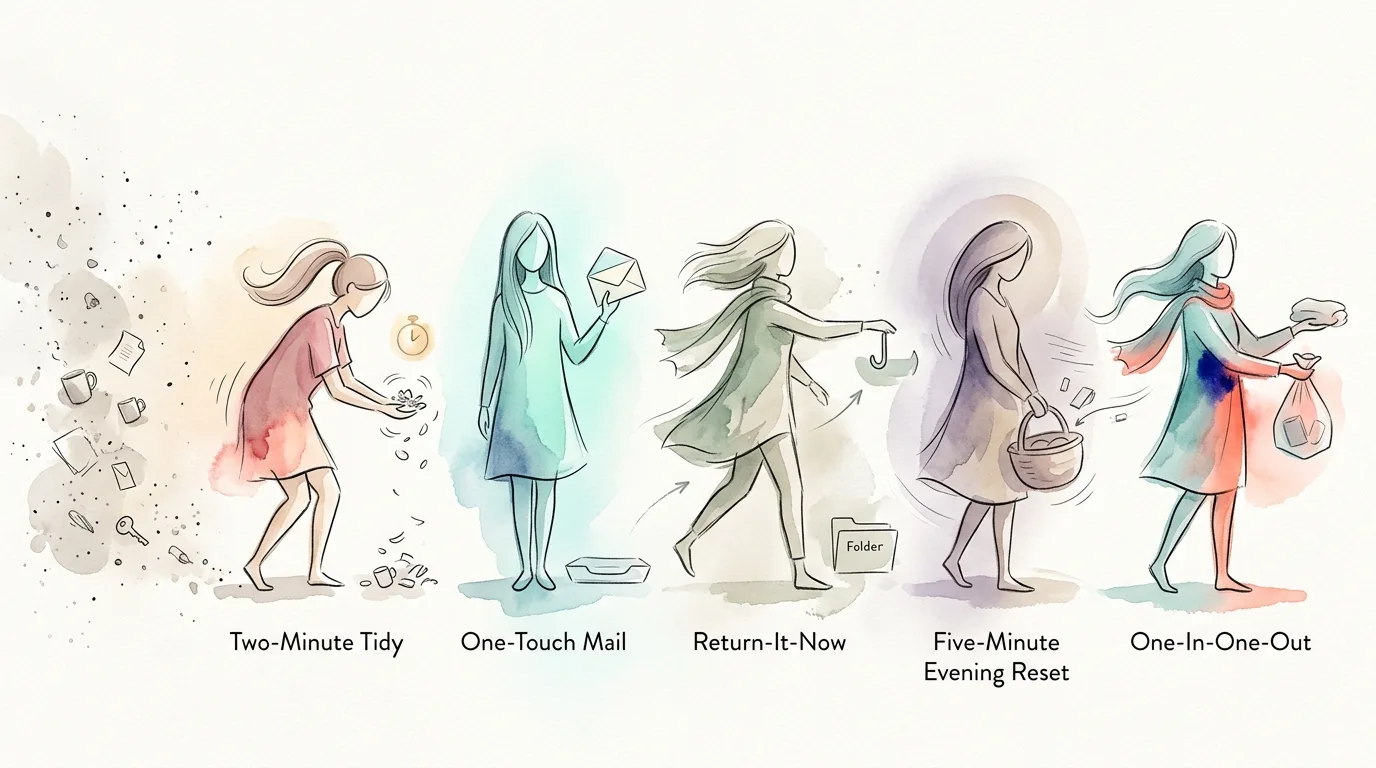
- The one-in-one-out rule: for anything new brought into the zone, take one similar item to donate.
This is where habit-stacking thinking helps: attach the micro-action to the original cue so you don’t have to remember two separate habits. For examples of stacking in a wardrobe context, see habit stacking for a minimalist wardrobe.
Days 15–21: Values check and weekly reset
By now the routine is familiar. Shift the focus slightly from “what did I do” to “why I did it.” Add a 60-second reflection once a week (or nightly if time allows): ask two questions—“What item, action, or purchase distracted me this week?” and “What small boundary can I set to avoid that next week?”
Schedule a 10-minute weekly reset tied to a weekly ritual (laundry day, Sunday morning coffee). Use that time to empty the donation box, clear one drawer, or unsubscribe from one marketing list. If you want help re-centering values and daily practices, read minimalist mindset daily practices.
Habit-stacking anchors that actually work
Pick a cue you already do without fail. Examples that make the check-in nearly automatic:
- After your first cup of coffee
- After brushing your teeth at night
- Before you sit on the couch in the evening
- When you hang up your keys at the entryway
Make the cue specific, immediate, and non-negotiable. The point is to reduce decision fatigue; stacking leverages an existing neural pathway.
Troubleshooting common obstacles
- “I forget.” Make the cue impossible to miss (move the coffee maker note, set a recurring phone alarm labeled “Check-in”).
- “I don’t have time.” Shrink the action. A 30-second scan beats waiting for a free hour to declutter.
- “This feels tedious.” Switch zones. Variety keeps the habit from feeling boring: kitchen counters on Monday, nightstands on Tuesday.
- “I fail sometimes.” Expect misses. A single lapse doesn’t erase progress. Return to the habit without shame—what matters is the long-term pattern.
How to measure progress (without spreadsheets)
Keep it simple. Use one or two of the following:
- A paper calendar with checkmarks for each day you do the check-in
- A running list labeled “donate/repair/sell” that grows over 21 days
- A weekly note in your planner: what felt lighter this week?
Quantify only if it motivates you. Often the clearest metric is how your space or decisions feel—less rushed, clearer counters, fewer impulse purchases.
After 21 days: next-step habits
If the routine stuck, reduce the active work: maintain a 1–2 minute daily check-in and keep a 10-minute weekly reset. Occasionally run a monthly purge or a seasonal audit. If the habit waned, restart with a smaller cue and shorter action—consistency will rebuild momentum faster than a larger, unrealizable commitment.
A daily minimalism check-in is less about rigid rules and more about becoming the kind of person who notices what belongs in their life. Small, repeated decisions compound. In three weeks you’ll either have formed a tiny habit that prevents clutter, or you’ll have learned exactly where your friction points live—and that knowledge is the beginning of lasting change.