How to Declutter Sentimental Items Without Decision Paralysis
A gentle, actionable system to sort sentimental items, beat decision paralysis, and preserve memories without clutter.
Why sentimental clutter feels like a special problem
Sentimental items aren’t junk. They’re anchors: gifts, kids’ artwork, souvenirs, old love letters. Each object carries a story, and when you stand in front of a pile of memories you shouldn’t throw away—decision paralysis sets in. You want to honor the memory, avoid regret, and still live in a calm, uncluttered space.
This post gives a nonjudgmental, step-by-step system to sort sentimental things without getting stuck. It blends mindset shifts, tiny habits you can actually keep, and clear decision rules so you move forward with confidence—not guilt.
Start with a kinder mindset
Decluttering sentimental items requires two mental shifts before you touch a single object.
- Memory is not the same as object. You don’t need everything to keep the feeling. A photo, a short note, or a single representative piece can hold the same meaning.
- Permission to change how you remember. Memories evolve; letting go doesn’t erase the past.
If you struggle with the emotional work of letting go, recognizing that this is normal helps. For many people, the first clue that accumulation has gone too far is a realization that the items are choosing you more than you’re choosing them—if that sounds familiar, this short reflection might help: The Moment I Realized I Had Too Much.
A four-part system to avoid decision paralysis
These steps reduce emotional friction, create structure, and make decisions fast and sustainable.
1) Prepare: set clear boundaries and small goals
- Choose a single place to start: a drawer, a box, a closet shelf.
- Limit the time: 20–45 minutes per session. Decision quality declines with exhaustion.
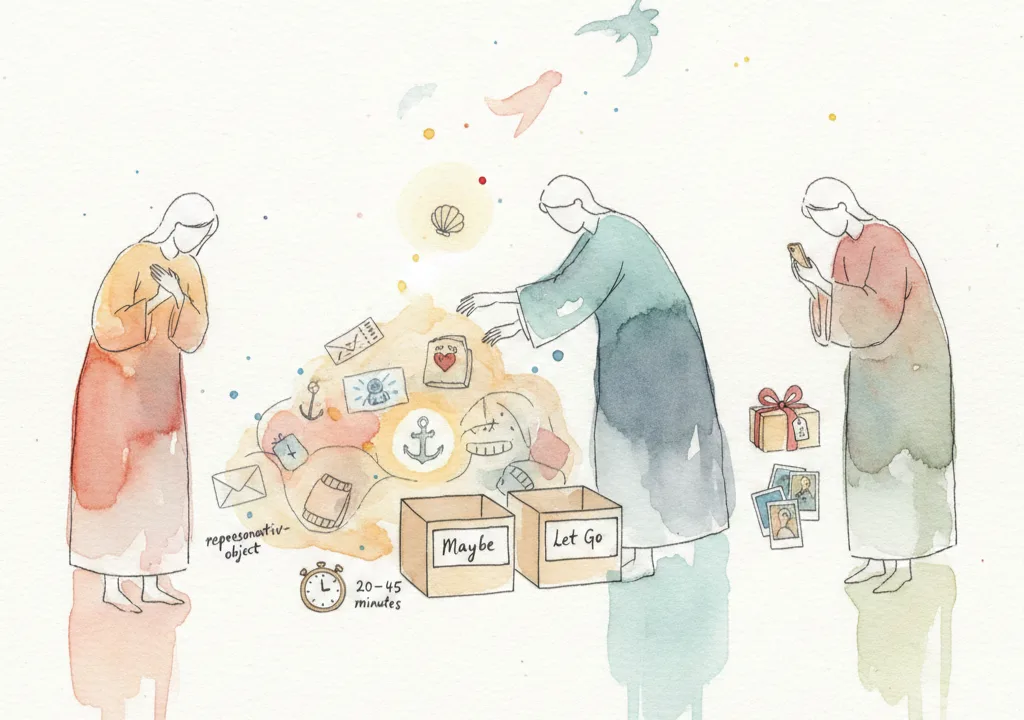
- Have supplies ready: three boxes or bags labeled Keep, Maybe, Let Go. A phone for photos. A small notepad for memories you want to preserve.
Why small and bounded? Decision paralysis grows when choice is unlimited. Constraints create clarity.
2) Use a short set of decision rules (your emotional triage)
Pick 3–5 simple rules to apply rapidly. Keep them posted where you’re working.
- Does it make you smile immediately? Keep it.
- Would someone else know you better because of this item? If yes, keep one item; if multiple pieces, choose the best.
- Is it broken or beyond reasonable repair? Let go—memories aren’t in the material condition.
- Is it tied to an unresolved relationship? Pause and put it in a time-locked box (see Rituals below).
- If you can’t decide in 30 seconds, move it to Maybe.
These rules lower the emotional stakes and help you sort by instinct instead of overthinking.
3) The representative-object rule
For categories like children’s artwork, travel souvenirs, or event programs, keep one or two representative items instead of everything. For example:
- Kids’ art: keep three favorites per year, photograph the rest.
- Souvenirs: keep the one that best captures the trip (the magnet, not every brochure).
- Apparel with memories: keep the patch, pocket, or a photo instead of the whole garment.
This preserves variety in your memory collection while dramatically cutting volume.
4) Digitize and curate
Digitizing is not a cure-all, but it’s a powerful tool. Take quick photos of items you don’t want to keep physically and store them in a labeled folder or a simple app.
- Limit digital backups too—create albums by person, year, or event.
- Write a one-sentence annotation for anything particularly meaningful; context matters more than quantity.
Digitizing transitions objects from space-takers to memory keepers, but don’t use it to avoid decisions. Snap, label, and let go.
Rituals that make letting go feel respectful
A ritual transforms disposal from rejection into intentional release.
- The Thank-You Pause: Hold an item, say aloud one sentence about what it meant, then place it in Let Go.
- The Time-Lock Box: For items tied to unresolved feelings—ex, things from an ex or a deceased relative—seal them in a dated box you revisit in 6–12 months. Often, the box stays closed.
- The Send-Off: For items that will be donated, write a small note about the item’s life and tuck it inside the donation bag. It’s symbolic, but it helps.
Rituals reduce guilt and give closure. They’re particularly useful if you find yourself hesitating at the last second.
Tiny habits to keep progress steady
You don’t need a marathon. Tiny, consistent efforts beat sporadic perfection.
- The 10-minute daily sort: Set a timer and work for 10 minutes on one drawer or box. Keep, Maybe, Let Go.
- Monthly memory audit: Once a month, open your Keep pile and remove anything that doesn’t still feel important.
- One-in-one-out for sentimental items: If a new meaningful item arrives, choose an existing one to remove or digitize.
If you’re familiar with tiny habit methods, these are easy to stack onto existing routines—put the timer on while you have your morning coffee, for example.
What to do with the Let Go pile
Deciding where items go after you remove them reduces second-guessing.
- Donate: Items with life left are useful to others. Drop off quickly; prolonged storage invites doubt.
- Recycle or shred: Papers with personal data should be destroyed.
- Photograph for memory + discard: Take one last photo for the album, then let the item go.
- Sell selectively: High-value keepsakes can fund a treat that supports your new lifestyle.
Choose a default route before you start decluttering and stick to it for that session.
When letting go feels like starting over
Sometimes surrendering things triggers a sense of loss beyond the object itself. That’s normal—and it’s covered in how to reframe the experience. If the feeling of starting over is overwhelming, this piece can help you walk through the emotional side: Why Letting Go Feels Like Starting Over.
Pair that reframing with the small habits above and the rituals, and you’ll find letting go becomes less about erasing the past and more about choosing how you want to live now.
Quick decision-aid checklist to print
- Time limit: ______ minutes
- Work zone: ______ (drawer/box/closet)
- Rules posted: smile / representative / broken / unresolved
- Digitize if: item is bulky but meaningful
- Default Let Go route: donate / recycle / sell
Use that checklist for each session until the rules feel natural.
Final notes: how to keep the change
Decluttering sentimental items isn’t a one-time project for most people. Treat it like a habit: small, repeated, and kind. The goal isn’t to be ruthless; it’s to create a home that supports your life and memories without making you feel overwhelmed.
If you’ve ever hesitated at the sight of a mound of memories, remember this: the object is not the memory. With a few decision rules, a tiny habit, and a respectful ritual, you can honor your past and make space for the present.